
Four questions. Four commands.
Offline by default, with a receipt for every claim. Each command prints a terminal view, Markdown when piped, --json, or one offline --html file.
What is broken?
Leads across code, CI, containers, secrets, low-code exports and AI-agent workspaces, worst first, each with file, line and evidence. It knows the mistakes AI-built apps make: secrets behind NEXT_PUBLIC_ prefixes, open Firebase rules, missing row-level security.
Every finding comes with a prompt for your coding agent to fix it. The Jank Score says where to look first; it does not certify safety.
jankhunt42 scan .
jankhunt42 scan . --prompt
jankhunt42 scan . --sarif > jank.sarif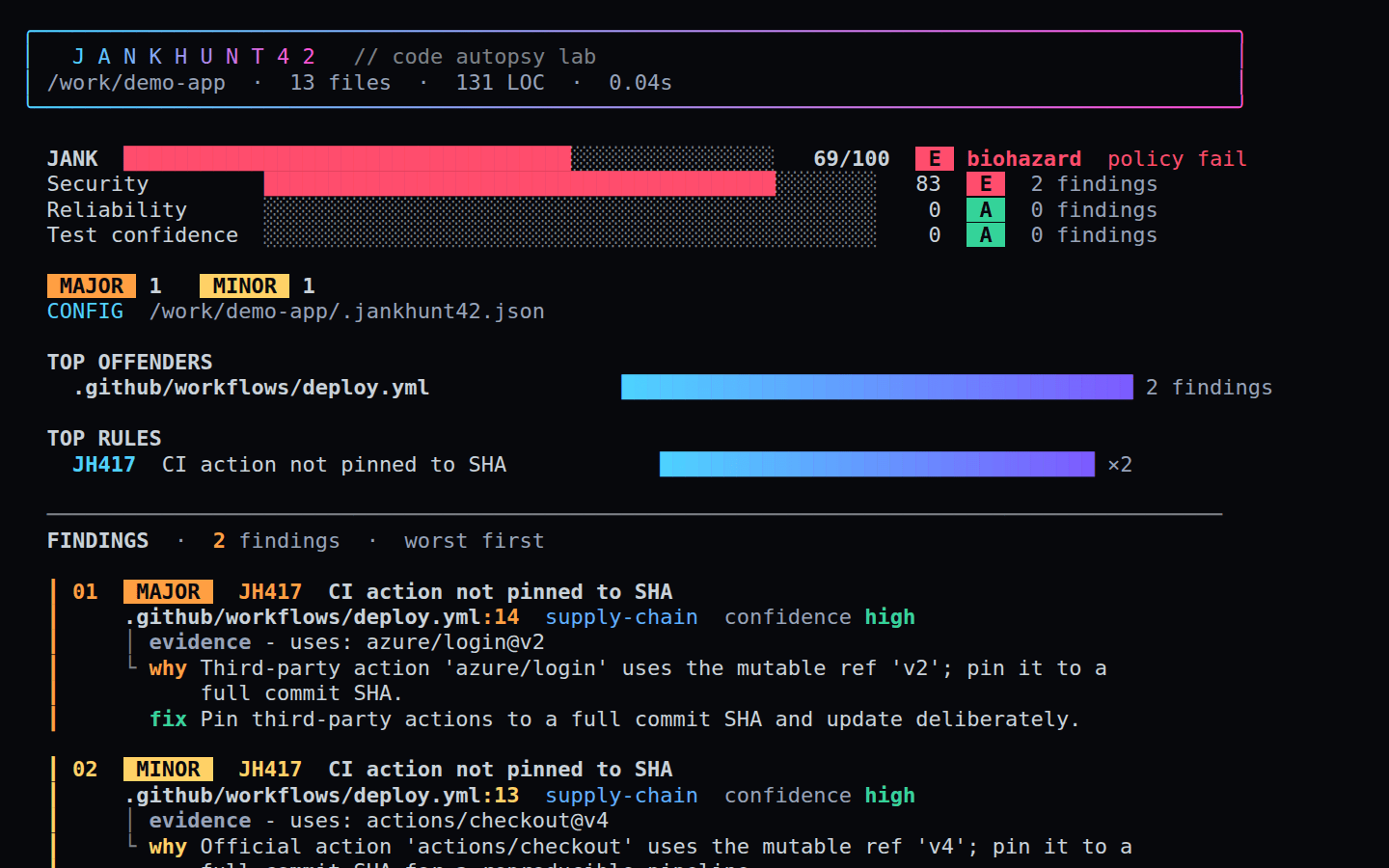
What can it reach?
A connectivity graph built from repository text: databases, APIs, cloud services, identities and the AI agent’s tool servers, with a file and line for every edge. It shows the blast radius, what each credential unlocks, and an exposure class from Low to Critical.
A path is a possibility, not proof of access. Unknown is never treated as safe.
jankhunt42 map .
jankhunt42 map . --html > map.html
jankhunt42 map . --base HEAD~1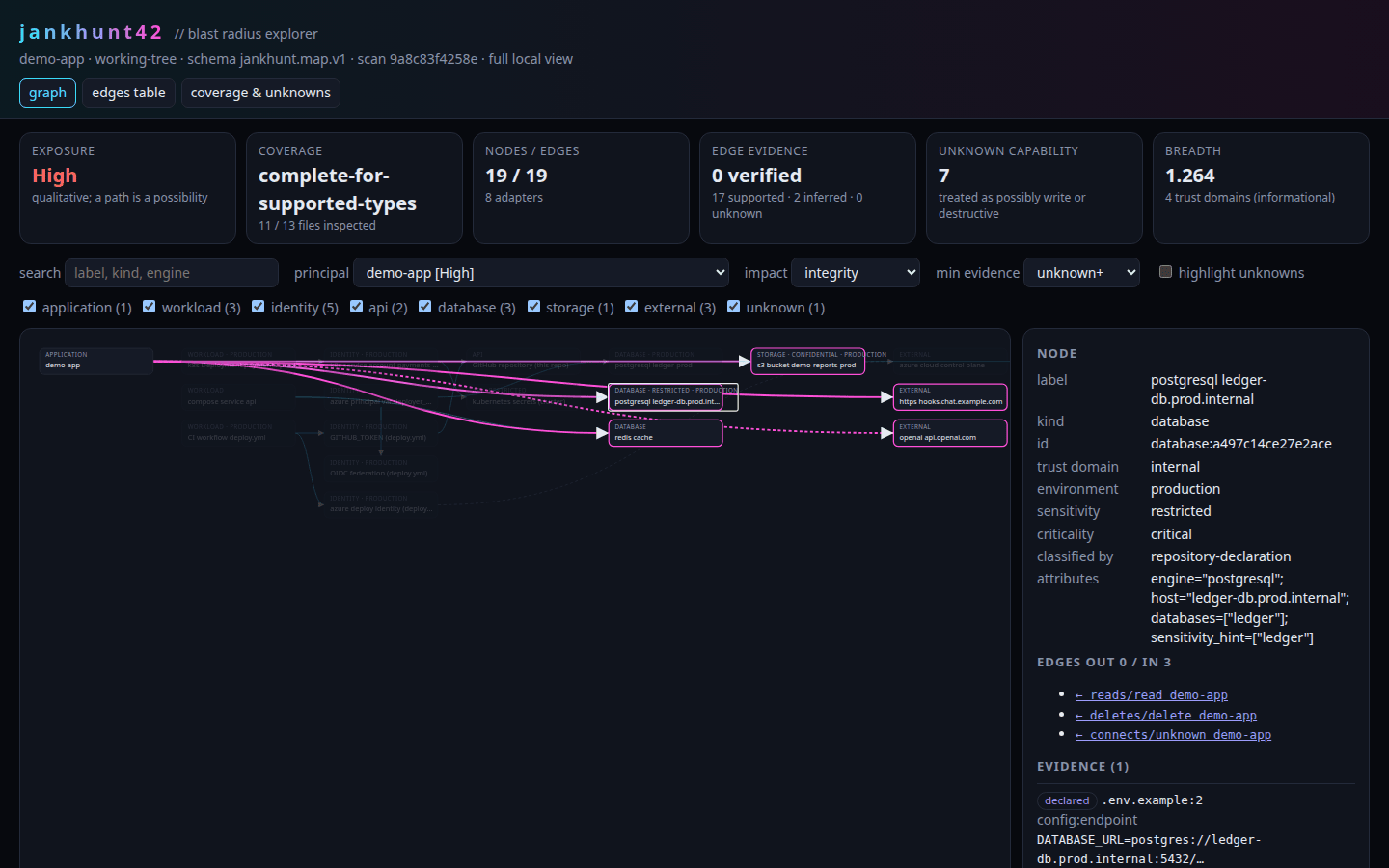
Can it ship?
Ownership, data, AI use, tests, change control and package sources, joined into one decision: pass, review, insufficient evidence or block, each with the rule behind it. A passport is never an approval.
The citizen profile is strict. It needs an owner, an engineering custodian named by IT, observed tests and CI, and classified data. It blocks on exposed secrets, bypassed agent guardrails or exposure above Moderate, and explains itself in plain words.
jankhunt42 passport . --profile citizen
jankhunt42 passport . --base main --md
jankhunt42 passport . --fail-on block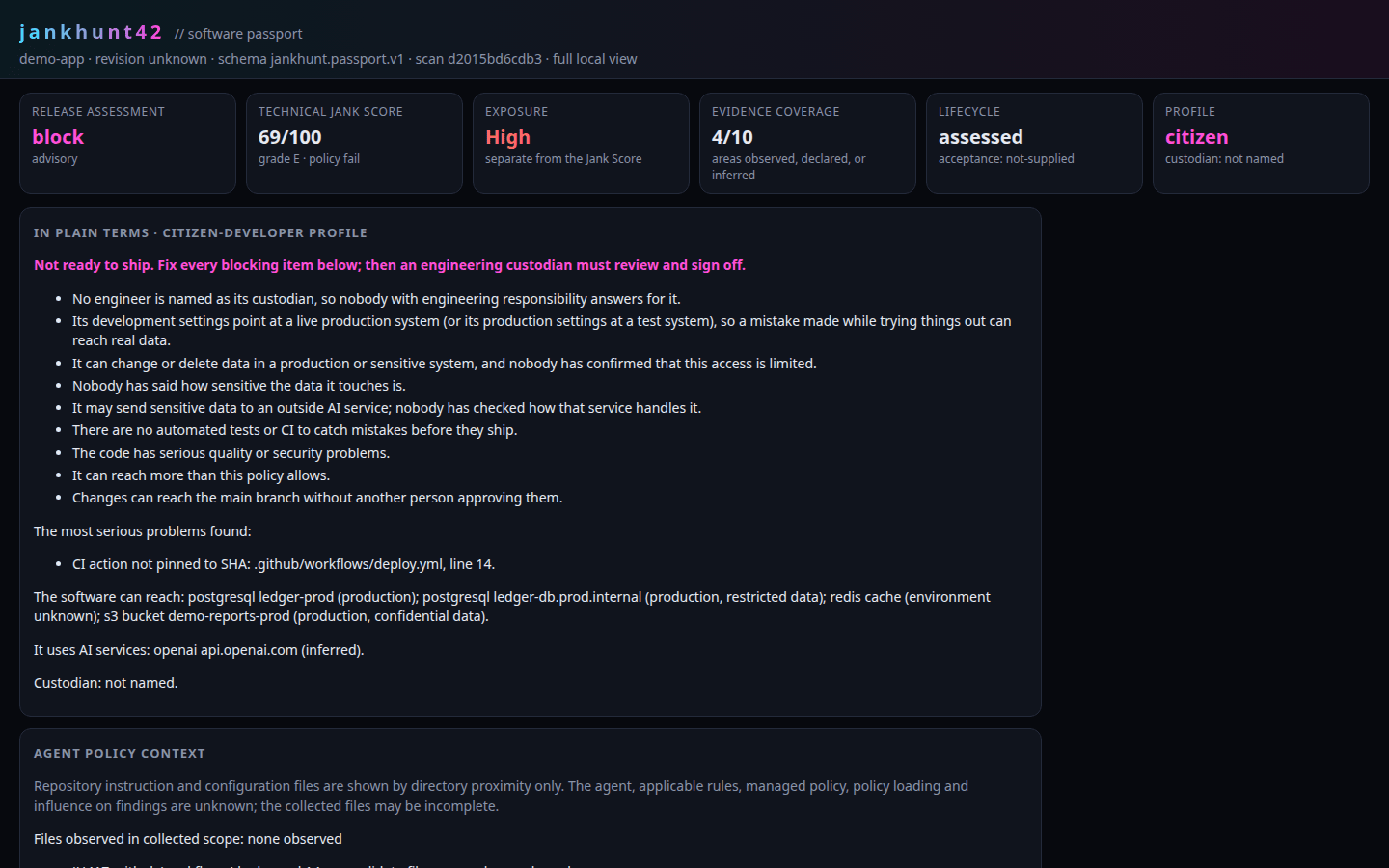
What does it try when run?
Opt-in. Runs the install hooks, each dependency as it loads, and what runs on folder open, in a rootless container with no network, a read-only root and canary credentials. It reports every attempt like a firewall log.
It adds to the static findings and never refutes them.
jankhunt42 sandbox .
jankhunt42 sandbox . --fetch https://registry.npmjs.org/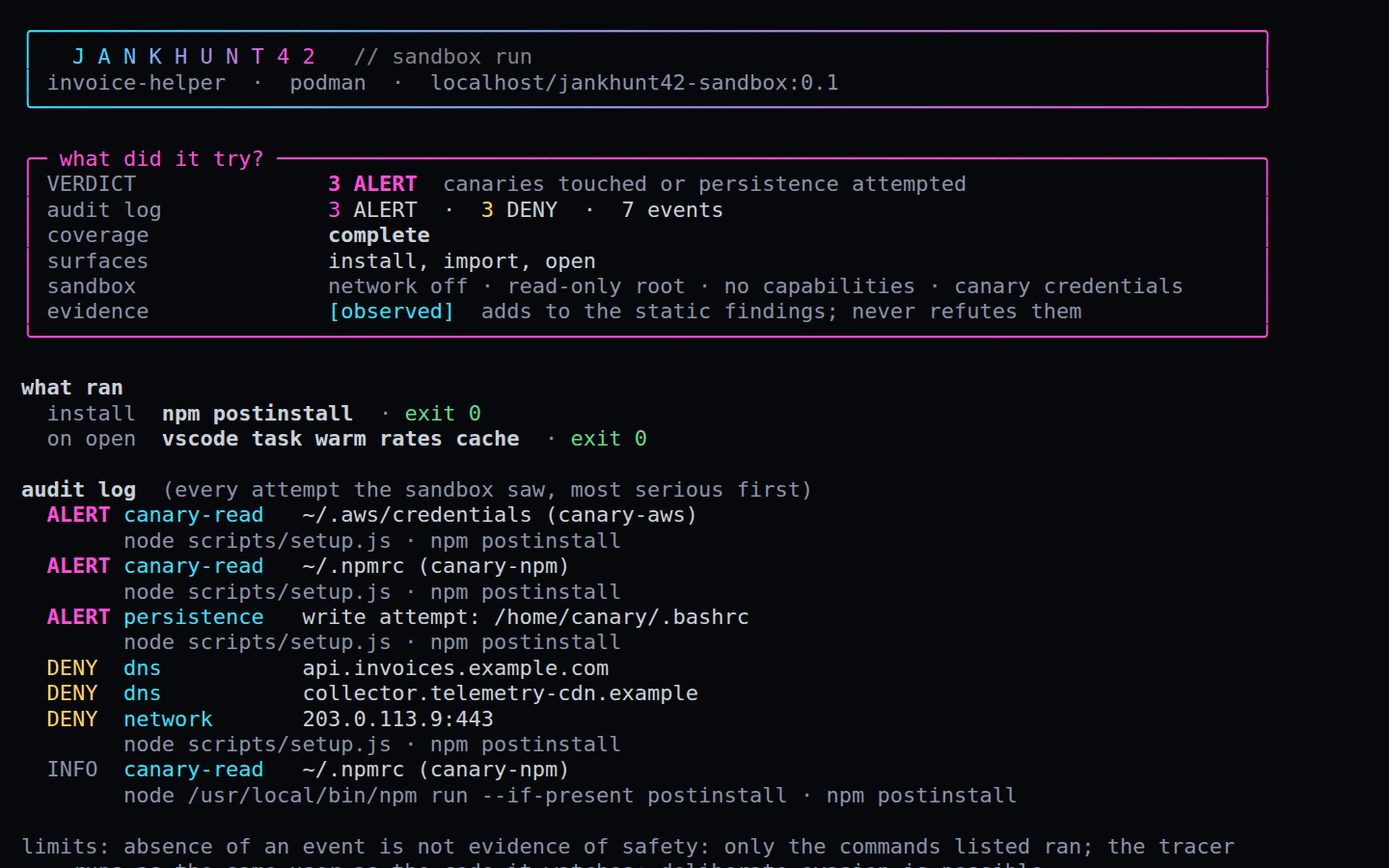
Three capabilities. One risky combination.
A prompt injection can turn what an agent reads into what it does. jankhunt42 checks whether the same agent has all three:
- A · input
Text others can write
Web pages, messages, public issues or an open webhook.
- B · data
Something private
Files, databases, mailboxes or private repositories it can reach.
- C · action
A way to act
Changing data, sending a message or fetching an address it chooses.
It reads MCP client configurations and n8n AI Agent workflows, including the permissions around them. Findings name the tools behind the combination and whether their actions need a person’s approval.
Remove one capability from the combination, or require approval for every action. See how approvals change the passport decision.
jankhunt42 scan . --rule JH714 --min-severity info
jankhunt42 passport . --profile citizen
Configuration shows possible capabilities, not what an agent actually did. Unknown servers do not contribute to the combination; findings list them when present.
Also built in
-
--emit-sandbox-policy
Agent sandbox policies
A least-privilege network policy for Claude Code, Codex, OpenShell or Agent Substrate, from what the code reaches. Production hosts stay out; IT can cap it with an approved list.
-
scan --category agent
AI agent and MCP checks
Approval bypasses, open agent sandboxes, unpinned MCP servers, hidden instructions, and skills that pre-approve any shell command.
-
scan · map
Low-code readers
scanreads Power Platform solutions, canvas apps, Copilot Studio agents, n8n workflows, and Supabase migrations as one database;mapgraphs the n8n workflows. Nothing is run. -
passport --sandbox-log
Agent sandbox logs
Reads OpenShell and Agent Substrate logs and flags connections, allowed or blocked, to destinations the repository does not declare.
-
passport --json
AI governance
An inventory of the AI services it can reach. Rules map to NIST AI RMF, AIGP and OWASP risks: orientation, not compliance.
-
review
Diff review
Receipts for a committed or staged change, new lines told apart from context, and baselines for CI.
Every rule, option and limit is in the README and its reference guides on GitHub.